What is a UGC drop? Deliverables, workflow, pricing, and usage rights
A UGC drop is a defined batch of creator assets delivered together. Learn how to scope the brief, deliverables, workflow, pricing, usage rights, QA, and measurement.

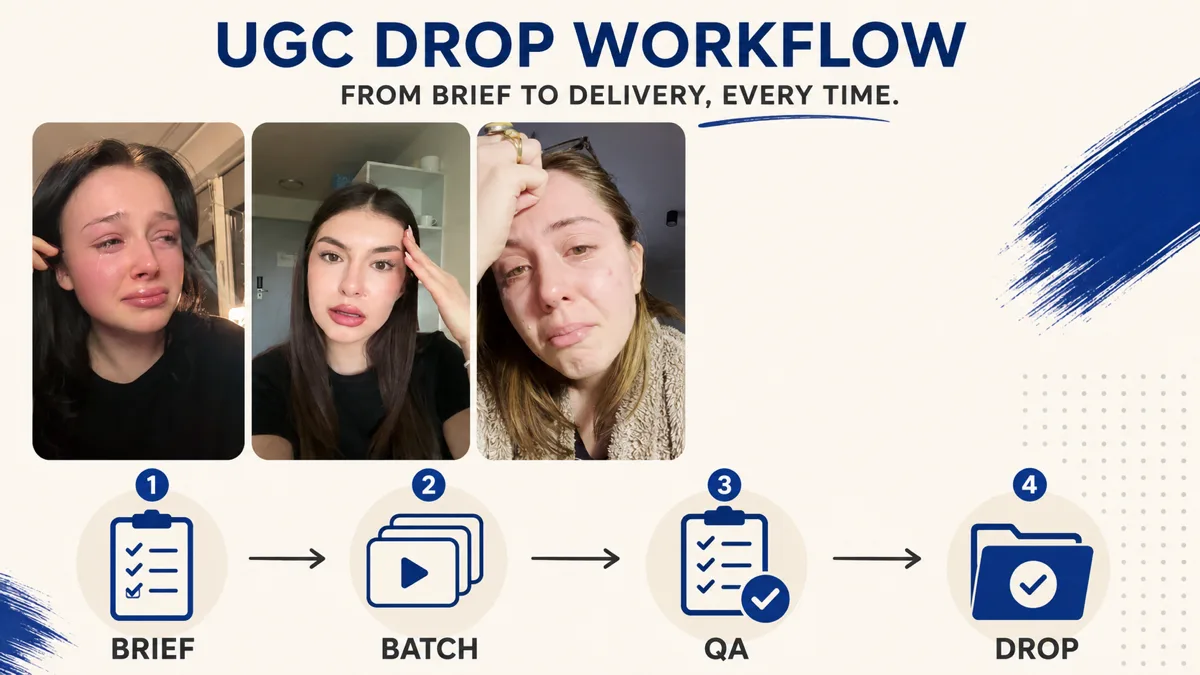
A UGC drop is a defined batch of creator content delivered on one agreed date or cadence. Instead of commissioning one video at a time, the brand approves one brief, a creator mix, a deliverables list, usage rights, and a review process. The result is a usable package of raw clips, edited videos, hooks, reactions, product shots, or other agreed assets. “UGC drop” is not a universal industry standard, so the contract should define exactly what a drop means before production starts.
What does “UGC drop” mean?
In this guide, the useful definition is operational: one brief, one scoped batch, one acceptance process, and one delivery point. A drop can happen once for a launch or repeat weekly or monthly as part of a content system. This describes a way to scope production, not a promise that every DansUGC package includes custom production or recurring delivery.
The word “drop” describes the delivery model, not a particular creative format. A drop might contain finished vertical ads, modular UGC clips, unedited creator footage, reaction videos, product demonstrations, voiceovers, stills, or a combination of them. The right mix depends on what the brand plans to publish and test.
That flexibility is useful, but it creates a risk: two people can agree to “20 pieces of UGC” while imagining completely different deliverables. A reliable drop replaces that ambiguity with a countable asset manifest.
Is a UGC drop different from a one-off video or retainer?
Yes. The main difference is how the work is scoped and delivered.
- One-off UGC video: one creator produces one defined asset. It is simple to buy but creates little variation.
- UGC clip library: the buyer licenses ready-made modular footage that can be reused across multiple edits.
- UGC drop: several related assets are produced or selected as one batch and delivered together.
- UGC retainer: an ongoing commercial relationship that may include one or more drops every month.
A drop is therefore a unit of production. A retainer is the longer agreement around those units. Brands can test a single drop before committing to a recurring cadence.
What should a UGC drop include?
The deliverable sheet should describe the files a buyer will actually receive. Avoid labels like “lots of content” or “ten concepts” unless each item has a clear definition.
A practical drop manifest can include:
- creator name or creator ID;
- concept, angle, and audience;
- number of hooks, bodies, calls to action, and b-roll clips;
- raw footage, edited versions, or both;
- aspect ratio, resolution, captions, and safe-zone requirements;
- target duration for each finished edit;
- filename and folder structure;
- revision allowance and review deadline;
- delivery date and delivery method;
- paid, organic, geographic, and time-based usage rights.
If the drop uses multiple creators, list the allocation by creator. “Five creators” is not enough. The buyer should know whether every creator supplies the same shot list or whether each person covers a different angle.
What is a sensible UGC drop workflow?
The strongest workflow has five controlled stages. Each stage prevents a different kind of waste.
1. Lock the testing job
Start with what the content must help the team learn. Examples include testing three opening hooks, comparing positive and skeptical reactions, building product-page proof, or creating a month of organic posts.
Do not begin with “we need more UGC.” Volume without a testing job creates a folder, not a content system.
2. Turn the job into an asset matrix
Map creators against creative components. A simple matrix might include three creators, two hooks per creator, one core product demonstration, and two calls to action. The matrix makes combinations visible before filming starts.
This is where modular production becomes powerful. A brand does not always need twelve unrelated scripts. It may need a smaller set of compatible openings, bodies, demonstrations, reactions, and endings that editors can recombine.
3. Approve the brief before production
The brief should cover the claim boundaries, pronunciation, visual references, wardrobe or setting constraints, product handling, prohibited statements, required shots, and delivery specification.
For reaction-led work, use a concrete UGC reaction video briefing checklist. Direction such as “look surprised” is too vague. Name the trigger, emotion, intensity, eyeline, timing, and usable pre-roll and post-roll.
4. Run technical and content QA
QA should happen against the manifest, not against memory. Check whether every file opens, matches the requested orientation and resolution, contains the expected shot, and complies with the brief.
Creative QA should also check performance usability: Is there clean space for text? Does the first usable action happen quickly? Can the raw clip be combined with other footage? Are captions and logos inside platform-safe areas? None of those questions guarantees performance, but they decide whether the asset can be tested properly.
5. Deliver a searchable drop
The final folder should be understandable to someone who did not manage production. Use predictable filenames and separate folders for raw clips, edited versions, captions, thumbnails, rights, and rejected or alternate takes.
A naming format such as `creator-angle-component-take-or-version` is more useful than files called `final-final-2.mp4`. Include the approved manifest and rights record beside the media.
A worked example: one drop is not twelve new concepts
Here is a hypothetical planning example, not a DansUGC package or campaign result. A study-app team needs footage for two messages: getting started on an assignment and reviewing notes. It has its own screen recordings and an editor, but needs human context around the product.
The team commissions two creators. Each supplies two opening reactions, one desk scene, and one closing reaction. That is eight raw components: four per creator. The editor then makes three finished versions per creator by combining selected footage with the app recording. That adds six exports, not six additional shoots.
The manifest should say eight raw components plus six finished edits, not fourteen original videos. Each export records its source clips, hook, app recording, and CTA. The second and third versions must change something worth learning, rather than only the filename.
If the team needs a creator to explain an app feature on camera, those silent reactions will not do the job. Add a scripted demonstration to the scope. If it only needs existing desk footage, a ready-made library may be the simpler purchase. The format follows the missing piece of the story.
For the copyable production document, use the separate UGC drop brief template and approval checklist. This guide explains the buying model; the template turns an agreed scope into instructions.
How is a UGC drop priced?
There is no honest universal price for a UGC drop because “a drop” does not specify the work. Price follows scope.
The main cost drivers are:
- number of creators and whether they are selected or custom-cast;
- number and complexity of concepts;
- quantity of raw clips and finished edits;
- scripting, creative direction, editing, captioning, and project management;
- product shipping, locations, props, or specialist requirements;
- paid advertising rights, organic rights, territory, and license duration;
- exclusivity, creator whitelisting, or identity usage;
- revision rounds and turnaround speed.
Compare quotes using the same manifest. One supplier may count every hook variation as a video while another counts the complete concept as one deliverable. A lower headline price can become expensive if the buyer still needs editing, usage rights, or replacement footage.
For current DansUGC options, compare the defined deliverables on the UGC packages page or build a custom scope through the order workflow. Treat visible prices and availability as current at the time you order, not as permanent promises inside a planning document.
What usage rights belong in the agreement?
Every drop should have a rights record that travels with the files. At minimum, state:
- whether use is allowed on organic channels, paid ads, or both;
- which brand, product, or legal entity receives the license;
- permitted platforms and territories;
- start date and end date, if the license expires;
- whether editing, cropping, captioning, voiceover, and compositing are allowed;
- whether the creator’s name, handle, likeness, or account identity may be used;
- whether whitelisting or Spark Ads access is included;
- whether the content is exclusive or can be licensed elsewhere.
Ownership and usage permission are not interchangeable. A brand may receive broad commercial usage without owning every underlying right forever. Put the actual arrangement in writing instead of relying on a platform message or invoice label.
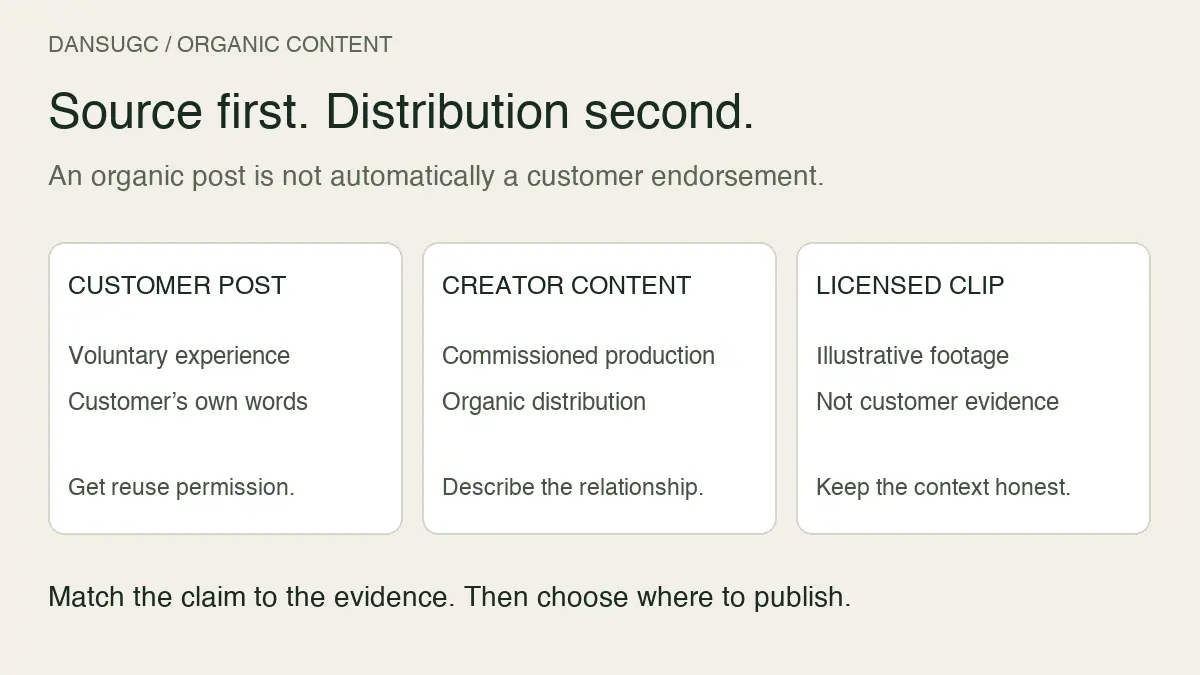
Also separate acting from testimony. A reaction filmed to direction is not evidence that the creator used or benefited from the advertised product. Do not edit a generic reaction into a false customer endorsement. For US-facing endorsements, the FTC disclosure guidance explains that material brand relationships should be disclosed clearly with the endorsement. Have the responsible reviewer check the final context. This is an operational checklist, not legal advice.
How many assets should be in one drop?
Work backward from the testing or publishing plan. If the team can only launch and review four new ads this week, receiving fifty unrelated edits may create more operational debt than value.
Count assets at the component level:
- How many distinct audience or problem angles need coverage?
- How many creators are needed to test delivery, setting, or demographic fit?
- How many hook variations can the media buyer launch cleanly?
- Which bodies or demonstrations can be reused?
- How many CTAs match the landing pages being tested?
This produces a smaller but more usable matrix. Scale the next drop after the team knows which components deserve more variations.
How do you judge whether a UGC drop worked?
Production success and campaign success are different.
First, score delivery quality: on-time rate, manifest completion, technical pass rate, first-pass approval, revision causes, and the percentage of footage that is actually usable. These metrics reveal whether the production system works.
Then measure the content in its real channel. For paid ads, that might include hook hold, click-through behavior, landing-page conversion, cost per acquisition, and revenue. For organic use, the team may track watch time, saves, shares, profile actions, and qualified site visits.
Do not assign a winner after one impression spike. Record the creator, angle, hook, body, CTA, and edit version so the next drop can repeat useful components rather than copying an entire video blindly.
When should a brand not buy a UGC drop?
A drop is the wrong purchase when the team has not defined the audience, offer, claim boundaries, approval owner, or distribution plan. In that situation, more files amplify confusion.
Start with one tightly scoped concept or a small set of ready-made clips when you still need to learn the visual language. Move to a drop when you can state what will be tested and who will use the assets after delivery.
Brands that need footage made to a brief can start a custom UGC order. Teams that already have a script and editor can browse the ready-made B-roll library and decide whether the next batch should be licensed, custom-produced, or mixed.
UGC drop checklist
Before approving production, confirm that you can answer yes to all of these:
- The term “drop” is defined in the agreement.
- Every deliverable is countable.
- The creator allocation is visible.
- Claims and prohibited statements are documented.
- Raw and edited file requirements are separate.
- Revision limits and deadlines are clear.
- Usage rights cover the intended channels.
- The folder and filename structure is agreed.
- One person owns consolidated feedback.
- The team knows how each asset will be published or tested.
If those ten points are clear, a UGC drop becomes a repeatable production unit rather than a hopeful pile of content.
Frequently asked questions about UGC drops
Is “UGC drop” a standard industry term?
No. It is used in several ways, including a batch of creator assets, a recurring content delivery, or a campaign opportunity released to creators. Define the term in the brief and contract instead of assuming both sides mean the same thing.
Can a UGC drop contain raw clips only?
Yes. A drop can contain raw modular footage, finished edits, or both. Raw-only drops work best when the buyer already has editing capacity and specifies framing, duration, clean audio, handles, and pre-roll or post-roll requirements.
Is a UGC drop the same as a monthly subscription?
Not necessarily. A drop is one delivery batch. A subscription or retainer can include recurring drops, but a brand can also commission one drop for a launch or controlled test.
Should one drop use one creator or several?
Either can work. One creator provides consistency. Multiple creators make it possible to compare delivery, setting, identity, and audience fit. The right choice follows the test plan rather than an arbitrary creator count.
What is the next step?
Define the asset matrix before requesting quotes. If you already know the creators, formats, counts, and rights you need, scope the drop with DansUGC. If not, compare the available UGC packages and use their deliverables as a starting point.
How this guide was made
I separated three buying paths visible on DansUGC on September 9, 2026: individual existing clips in the B-roll library, format-based packages, and orders made to a brief. The custom-order page asks buyers to pick a format before choosing a creator. These are different products, even when all three are described as UGC.
The workflow and acceptance criteria above are recommendations, not a claim about measured turnaround or campaign performance. The study-app example is hypothetical. No market-average price, guaranteed result, or universal drop size is assumed.
Ready to get UGC videos for your brand?
Real human creators, 48-hour delivery, 12-month commercial license. Starting at $9/video.